PH4NTXM
Engineered for zero-trace execution in hostile environments.

PH4NTXM Operating System

Freedom • Security • Anonymity • Hostile-Environment Ready
Intent Document Features Pricing & Licensing Contact & Ordering GitHub
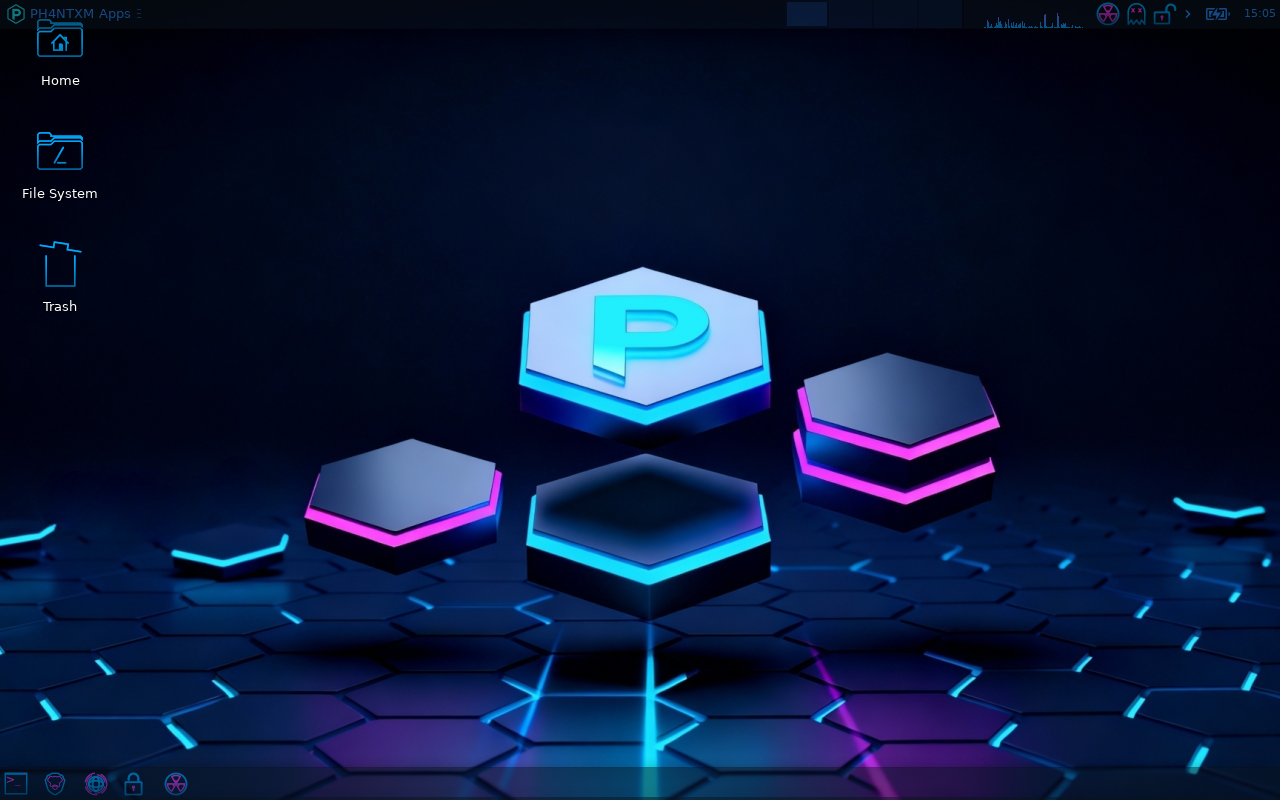
PH4NTXM Desktop Environment

PH4NTXM — SYSTEM DOCUMENT

Overview

PH4NTXM is an Adaptive Identity Engine embedded within a live-only, stateless operating system. It is engineered for high-risk forensic research environments where compromise, seizure, or deep inspection are treated as inevitable conditions.

The system operates entirely in volatile memory and regenerates its identity per session. No persistent identifiers, hardware-derived traits, or historical artifacts are carried across executions.

Its architecture focuses on reducing attribution risk by eliminating persistence, enforcing cross-layer identity coherence, and introducing controlled behavioral variability.

Why PH4NTXM?

Modern systems assume continuity. Identity persists, behavior stabilizes, and over time, small observable signals accumulate into a coherent fingerprint.

In environments where observation is continuous and correlation is the primary attack vector, persistence becomes liability. Even well-configured systems expose patterns across network behavior, timing, and identity layers that can be linked over time.

PH4NTXM exists to break this model. Instead of attempting to hide a stable system, it removes continuity entirely.

Each session is treated as an independent instance, with no historical linkage, no persistent identity, and no assumption of trust in prior state.

The goal is not obfuscation, but non-correlation — ensuring that what is observed cannot be reliably tied to what came before.

Design Goals

PH4NTXM is built around a small set of constraints: eliminate persistent state, prevent stable fingerprint formation, and ensure that observable system behavior remains plausible and internally consistent.

Identity, network behavior, and system characteristics are derived per session and coordinated across layers. Variability is introduced within realistic bounds to avoid both determinism and anomalous noise.

These goals define the system’s architecture and take priority over convenience, compatibility, or traditional desktop expectations.

Threat Model

PH4NTXM assumes continuous observation by passive and active entities, including network-level inspection, infrastructure monitoring, and post-execution forensic analysis.

The system is designed to resist correlation across sessions by removing stable identifiers and preventing the formation of consistent behavioral fingerprints across network, timing, and identity layers.

It does not attempt to compensate for unsafe operational practices or compromised environments. Security guarantees apply within the system’s defined execution model.

Operational Considerations

PH4NTXM prioritizes determinism of behavior over recoverability. Certain actions are intentionally irreversible, and system state is designed to be transient by default.

Features such as volatile identity, controlled teardown mechanisms, and strict network enforcement are integral to the system’s design and are not intended to be bypassed or relaxed.

Effective use requires understanding the system’s constraints and operating within its intended model.

Source Model & Continuity

PH4NTXM is developed as a controlled-distribution system rather than a fully public open-source project.

This model preserves consistency in design assumptions, reduces fragmentation, and allows the system to evolve without introducing unintended behavioral divergence.

Source code access is provided to licensed users for audit and verification, enabling transparency without exposing the system to uncontrolled redistribution.

Intended Audience

PH4NTXM is intended for operators, researchers, and professionals working in environments where attribution, correlation, or inspection risk must be actively managed.

It is not designed as a general-purpose operating system or a casual privacy layer, and assumes a level of operational discipline from the user.

Documentation Access

This document outlines system intent and design philosophy. Detailed implementation, configuration, and operational guidance are provided separately under controlled access.

This separation ensures that high-level behavior is understood without exposing sensitive implementation details that could reduce the system’s effectiveness.

PH4NTXM — FEATURES

0. Boot Persona System

PH4NTXM selects a deterministic persona at startup: LINUX, WINDOWS, ANDROID, or LONEWOLF.

Persona selection occurs before any externally observable subsystem initializes, ensuring that all identity surfaces are constructed from a unified model.

This prevents cross-layer inconsistencies and reduces classification through multi-signal correlation.

Lonewolf is a fully isolated execution mode designed for maximum network containment.

All traffic is routed exclusively through Tor, with no clearnet communication permitted.

DNS is contained, IPv6 is disabled, and all communication follows a strict fail-closed policy.

1. PH4NTXM Identity

Provides visibility into the active synthetic system identity across hardware, network, and application layers.

All values are derived from the active session identity graph and reflect the persona selected during boot.

The information is read-only and allows validation of system state without modifying behavior.

2. Identity Generation Engine

Identity is generated per session using deterministic derivation.

A persona seed combined with boot-time entropy is expanded through hash-based mapping into structured identity components.

This ensures internal consistency while preventing reuse across sessions.

3. Deterministic Identity Graph

All identity components are derived from a single structured graph.

Hardware, network, and application-level attributes are interconnected and generated through consistent rules.

Changes in one layer propagate deterministically across all others.

4. Layered Identity Model

Identity is structured into stable, session, and bounded-noise layers.

Stable traits emulate hardware invariants, while session and noise layers introduce controlled variability.

Variability remains within realistic bounds to preserve plausibility.

5. Boot Entropy Anchor

A boot-time entropy component influences identity derivation.

This ensures that each execution produces a unique system instance.

Identity remains deterministic within the session lifecycle.

6. Generated Identity Surface

PH4NTXM synthesizes a complete observable system surface.

This includes machine-id, hostname, MAC addresses, DMI data, CPU, memory, GPU, display, DHCP identity, and TCP/IP behavior.

All components are interdependent and derived from the same identity graph.

7. Hardware Identity Virtualization

Hardware identity is fully synthesized and injected at runtime.

DMI/SMBIOS data, UUIDs, serials, and vendor mappings are generated and exposed through virtualized interfaces.

These values follow realistic structure and vendor alignment.

8. CPU Identity Virtualization

CPU identity is constructed and exposed via /proc/cpuinfo.

Core count, threading, and frequency behavior are derived from device class and system profile.

Frequency includes controlled variation within realistic limits.

9. Memory Identity Modeling

Memory configuration is derived from constrained hardware profiles.

Valid configurations are selected deterministically from realistic sets.

Limits are enforced to prevent impossible system combinations.

10. Graphics Identity Virtualization

The rendering stack is fully synthesized and controlled.

GPU vendor, model, driver exposure, and capabilities are aligned with system identity.

Rendering behavior is shaped to match expected hardware capabilities.

11. Display & Screen Model

Display parameters are derived from GPU capability and device class.

Resolution, refresh rate, and pixel density follow realistic patterns.

Output characteristics remain consistent with rendering capabilities.

12. Application Fingerprint Layer

Application-level identity is derived from system identity.

Browser fingerprint surfaces such as viewport, scaling, and rendering behavior are aligned with the synthetic system.

Measurements remain consistent across DOM and rendering layers.

13. Network Personality Engine

Network stack behavior is dynamically shaped based on persona.

Parameters such as TTL, window sizes, retransmissions, and congestion control reflect realistic system profiles.

Behavior remains consistent within flows.

14. Packet-Level Transformation Engine

Network traffic is actively rewritten at the packet level.

TCP sequence behavior, timestamps, option ordering, and flow characteristics are controlled.

Behavior remains stable per destination while varying globally.

15. Behavioral Drift Engine

Network characteristics evolve gradually during runtime.

Latency, jitter, and timing behavior change within controlled limits.

Drift remains bounded to preserve realism.

16. DNS Resolver System

DNS resolution is handled locally through encrypted channels.

Features include DNS over TLS, DNSSEC, query minimization, and upstream rotation.

Resolver behavior follows realistic caching patterns.

17. Identity State Engine

All runtime identity data is centralized in memory.

The state layer acts as a single source of truth across subsystems.

No identity data is written to persistent storage.

18. DHCP Identity Enforcement

DHCP identity is fully controlled and persona-aligned.

Hostnames, vendor classes, and request patterns are consistent.

Behavior remains stable across reconnects.

19. Firewall Enforcement Engine

All traffic is filtered through a strict default-deny model.

Only explicitly permitted flows are allowed.

Unexpected or unsolicited traffic is dropped by default.

20. Firewall Integrity Protection

Firewall rules are continuously validated against known-good states.

Only predefined configurations are permitted, including normal and lockdown states.

Unauthorized modifications are automatically reverted.

21. System Hardening

Kernel exposure is minimized and sensitive interfaces are restricted.

Unsafe network behaviors are disabled at the system level.

Strict validation is applied across critical subsystems.

22. Volatile State Architecture

All system state exists exclusively in RAM.

No data persists across reboots or session termination.

Identity and runtime artifacts are fully ephemeral.

23. Lockdown Mode

Instantly blocks all network traffic, cutting off all external communications.

System remains active without any form of connectivity, ensuring isolation from the network.

Treated as a valid firewall state, blocking all inbound and outbound traffic.

24. Panic Button

Immediately terminates execution of all active processes, halting system activity.

Drops network connections and terminates processes, ensuring full isolation from the external environment.

Destroys volatile state, effectively wiping all session data in memory.

25. USB Trigger System

A removable USB device can act as a physical emergency trigger.

When armed, device removal initiates immediate system teardown.

The mechanism operates independently of software interaction.

26. Nuke Kernel

A secondary kernel path is used for secure system teardown.

Execution is transferred away from the primary environment.

Memory state is invalidated during the teardown process.

27. Cryptographic Stack

Hybrid cryptography integrates classical and post-quantum primitives.

Protocols support forward-secure key exchange.

Quantum-resistant mechanisms are available where applicable.

PRICING & LICENSING

Licensing Model

PH4NTXM is distributed under a commercial license and delivered on demand. Each license grants time-limited access to the system and its update stream. Licenses are issued per operator or organization and are not transferable.

Distribution is intentionally controlled to preserve build integrity, maintain a consistent threat model, and support long-term continuity of the platform.

Update Policy

Updates are released on a fixed quarterly cadence. Each update may include security improvements, behavioral changes, and system refinements aligned with the platform’s operational goals.

Updates are cumulative and must be applied in sequence within the active license period.

License Options

12-Month License
Duration: 12 months
Included updates: 4 (1 update every 3 months)
Price: USD 149 — settled in Monero (XMR) at current market rate
24-Month License
Duration: 24 months
Included updates: 8 (1 update every 3 months)
Price: USD 199 — settled in Monero (XMR) at current market rate

Delivery & Renewal

PH4NTXM is built and delivered individually upon request. No public downloads are provided. License renewal is required to continue receiving updates beyond the licensed period.

Renewal terms and continuity options are discussed directly during the ordering process.

Pricing reflects controlled distribution, ongoing development, and long-term platform maintenance.

Licensing grants time-limited usage rights and access to updates only. Ownership of the software and its components is not transferred.

CONTACT & ORDERING

Procedure

PH4NTXM is delivered on demand to preserve build integrity and reduce exposure. Requests are accepted only through encrypted communication.

CONTACT ENDPOINT:
PH4NTXMOS@proton.me

Instructions

Requests that do not follow these guidelines may not receive a response. This is done to reduce unnecessary exposure and to protect both parties.

Privacy is treated as a fundamental right, not a conditional privilege.

  1. Use a privacy-respecting email provider.
  2. Encrypt all messages using the public PGP key.
  3. Include only the minimum information required for the request.
  4. Avoid unnecessary personal or identifying details.
  5. Strip metadata from any attached material.

Public PGP Key

Copy the full block. Partial keys are unusable.

-----BEGIN PGP PUBLIC KEY BLOCK----- mDMEaYtVJhYJKwYBBAHaRw8BAQdAbXg9gyUOBM+6RFHM3mZjKWXfzjo2Mxh7Y2XD MVYMVa20HVBINE5UWE0gPFBINE5UWE1PU0Bwcm90b24ubWU+iJAEExYKADgWIQSB T4gbCzB3plMiHOSvap3j7pe7nAUCaYtVJgIbAwULCQgHAgYVCgkICwIEFgIDAQIe AQIXgAAKCRCvap3j7pe7nA87AQDFIF3Xm2P7JOgprUXL/P/z3PrRDoOBQIkhBtns XBTKjwD+MpawEeG1+D/zqtNDW3j/+eO1TMZqJdMb9vxNAjxgrA+4OARpi1UmEgor BgEEAZdVAQUBAQdA2hv3KqFcO8mEQrGPI9Z1hkHmY4A4xUK0UabeK6CDHE4DAQgH iHgEGBYKACAWIQSBT4gbCzB3plMiHOSvap3j7pe7nAUCaYtVJgIbDAAKCRCvap3j 7pe7nBdzAP93dcGpqPjTbGqmilOkNrgxbPz7FqOcmaXgr4zN+JBBCQD+KXXPmk64 kV+MQFuel2JraCnoph5ITN2nthRsYmdmoQc= =1BEZ -----END PGP PUBLIC KEY BLOCK-----

Secure transmission is the only acceptable channel.

Processing Policy

All incoming emails are processed through a strict, time-ordered queue. Requests are handled sequentially to ensure fairness and operational integrity. Please allow up to a 48-hour response window before follow-ups.

INTENT

In a world of continuous surveillance, persistent identity, and systems that assume permanent observation, PH4NTXM OS was created to offer an alternative.

The project exists for those who believe that privacy is not a feature, a setting, or a promise, but a condition that must be designed into the environment itself. Sessions are isolated, state is not retained, and continuity is treated as optional rather than assumed.

PH4NTXM OS prioritizes clarity over convenience and intention over automation. It does not attempt to manage behavior or guide outcomes, but instead provides a clean operational space where control remains explicit and temporary.

This system is built for operators who value discretion, autonomy, and the right to operate without leaving unnecessary traces behind, understanding the cost of that choice.

— Stay secure, stay safe, stay PH4NTXM.

PH4NTXM Signature